
A Busload Full of Work
A bus breaking down can create a difficult roadside situation. Especially when it stops somewhere with little room for a tow truck to maneuver. A full-size bus takes up considerable space, and even reaching the right end of it can be a challenge. For I-35 bus towing, the position of the bus can determine what needs to happen before normal towing preparation begins.
An engine problem might be straightforward to deal with mechanically. But if the bus is sitting at an angle or blocking access? Then getting close enough to hook it up can be another matter entirely.
There’s a Lot of Bus to Work Around
A full-size passenger vehicle takes up considerably more room than a car or pickup truck. Its long wheelbase and extended bodywork affect where a heavy-duty wrecker can be positioned and how much space crews have to work.
Think about a bus stopped close to a guardrail or angled across a narrow shoulder. Even if its wheels and steering are in good condition, the tow truck may not have a clear approach.
The front and rear overhangs matter, too. A bus can extend several feet beyond its axles, leaving crews with more bodywork to account for when repositioning it.
Sometimes moving the bus a short distance is what makes the rest of the job possible.
Sometimes You Have to Move It Before You Can Tow It
A bus can be mechanically ready for towing without being in a position where the tow truck can connect to it.
That’s where repositioning comes in. Depending on the situation, crews may need to move the bus into a more accessible location before setting up for transportation. If it has left the roadway or sustained collision damage, the work may be more involved.
There’s an important distinction here. Recovery deals with getting the bus out of its difficult position. Towing gets it to the repair facility or another destination.
Not every breakdown requires both stages, but an awkward stopping position can turn an otherwise ordinary tow into a bigger job.
Once We Can Reach It, What Condition Is It In?
Getting access to the bus doesn’t automatically mean it’s ready to travel. Crews still need to determine whether its wheels, steering, suspension, and drivetrain can handle the proposed towing arrangement.
An engine failure may leave those systems working normally. Collision damage could leave a wheel pointing in the wrong direction or a suspension component unable to support normal movement.
Before making the hookup, several things deserve attention:
- Bus type and size: School buses, motorcoaches, and shuttles have different dimensions.
- Wheel and tire condition: Damaged wheels may prevent normal rolling.
- Steering: The bus needs to track properly during transportation.
- Suspension: Damage can affect how the vehicle sits and moves.
- Drivetrain: The configuration determines what preparation may be needed.
- Clearance: Bodywork and undercarriage components must clear the pavement.
For commercial bus towing on I-35, these checks help determine what needs to happen before the bus can leave the scene.
Lifting One End Changes the Whole Bus
A bus doesn’t sit at its normal angle once one end is raised by a heavy-duty wrecker. That change can bring the opposite end closer to the pavement.
During heavy-duty bus recovery around I-35, crews have to consider what happens to the bus’s long body after the hookup. A rear overhang that clears the road while parked may sit lower when the front is lifted.
And that clearance still matters when the combination encounters a driveway, a turn, or a change in pavement elevation.
The Drivetrain Has Its Own Requirements
Not every bus has the same mechanical layout. School buses, transit buses, motorcoaches, and shuttles can differ in axle arrangements and drivetrain components.
For heavy bus towing near I-35, crews need to know which wheels will remain on the road and what preparation is required to protect the equipment. Simply having enough towing capacity doesn’t answer those questions.
What Happens to the Passengers?
A disabled bus can leave two separate transportation problems: the people who were riding in it and the bus itself.
Passengers may need another bus or other arrangements made by the appropriate parties. Once they’re taken care of, bus towing in the I-35 corridor can focus on moving the disabled equipment.
The bus might be empty by then, but its length, mechanical condition, and awkward position haven’t changed.
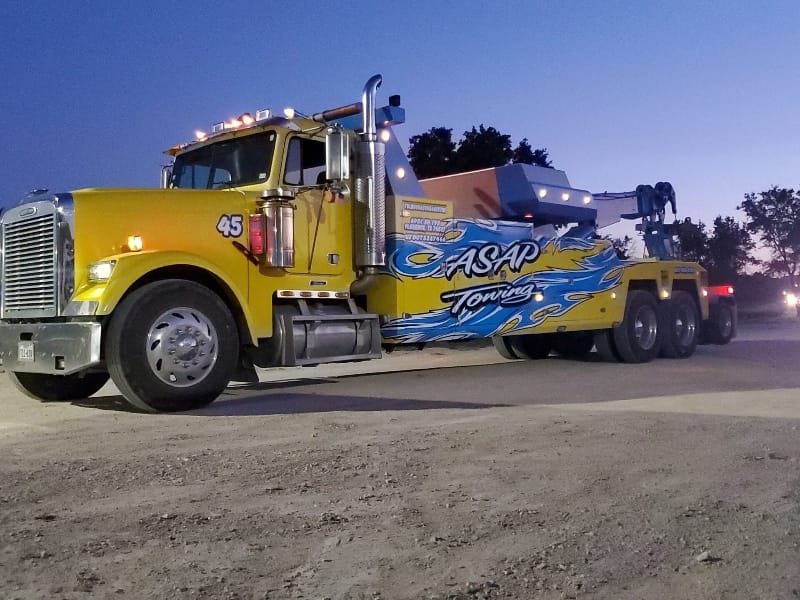
ASAP Towing & Heavy Duty Semi Truck Wrecker for I-35 Bus Towing
At ASAP Towing & Heavy Duty Semi Truck Wrecker, we serve Central Texas with heavy-duty towing and recovery services. When a large vehicle breaks down in a difficult location, there’s more to consider than whether the tow truck has enough pulling power. We need to look at access, the vehicle’s condition, and what it will take to get everything moving.
A disabled bus can bring its own challenges, from limited working room to damaged wheels or steering components. For heavy bus towing along I-35, our approach starts with understanding the situation rather than assuming every heavy-duty tow works the same way.
Frequently Asked Questions
Does a bus have to be repositioned before it can be towed?
Not always. If the bus is difficult to access, sitting at an awkward angle, or off the roadway, repositioning may be necessary before towing begins.
Why does the position of a disabled bus matter?
A large bus needs adequate working room for the tow truck and its equipment. Guardrails, narrow shoulders, and the angle of the bus can all limit access.
Can a bus with an engine failure still roll normally?
Yes. An engine problem doesn’t automatically mean the wheels, steering, or suspension are damaged. Those systems still need to be checked before towing.
Why does the drivetrain matter during a bus tow?
Different buses have different drivetrain and axle configurations. Crews need to understand that layout to determine how the bus should be prepared for transportation.
What happens to passengers when their bus breaks down?
Passenger transportation is handled separately from the disabled bus. The appropriate parties may arrange another bus or another way for passengers to continue their trip.
Does lifting a bus change its ground clearance?
It can. Raising one end changes the angle of the body, which may bring the opposite overhang or underbody components closer to the pavement.